Troy, N.Y. -- Researchers at Rensselaer Polytechnic Institute have developed a new method to bond materials that don’t normally stick together. The team’s adhesive, which is based on self-assembling nanoscale chains, could impact everything from next-generation computer chip manufacturing to energy production.Less than a nanometer – or one billionth of a meter – thick, the nanoglue is inexpensive to make and can withstand temperatures far higher than what was previously envisioned. In fact, the adhesive’s molecular bonds strengthen when exposed to heat.The glue material is already commercially available, but the research team’s method of treating the glue to dramatically enhance its “stickiness” and heat resistance is completely new. The project, led by Rensselaer materials science and engineering professor Ganapathiraman Ramanath, is featured in the May 17 issue of the journal Nature.Like many key scientific discoveries, Ramanath and his team happened upon the novel, heat-hardened nanoglue by accident.
Friday, October 17, 2008
Inexpensive 'nanoglue' can bond nearly anything together
Troy, N.Y. -- Researchers at Rensselaer Polytechnic Institute have developed a new method to bond materials that don’t normally stick together. The team’s adhesive, which is based on self-assembling nanoscale chains, could impact everything from next-generation computer chip manufacturing to energy production.Less than a nanometer – or one billionth of a meter – thick, the nanoglue is inexpensive to make and can withstand temperatures far higher than what was previously envisioned. In fact, the adhesive’s molecular bonds strengthen when exposed to heat.The glue material is already commercially available, but the research team’s method of treating the glue to dramatically enhance its “stickiness” and heat resistance is completely new. The project, led by Rensselaer materials science and engineering professor Ganapathiraman Ramanath, is featured in the May 17 issue of the journal Nature.Like many key scientific discoveries, Ramanath and his team happened upon the novel, heat-hardened nanoglue by accident.
computer circuit that can build itself
A team of European physicists has developed a unique computer circuit that can build itself - a development that can lead to self-assembling computers.The Physicists have developed an integrated circuit that can build itself.
The work is an important step towards its ultimate goal - a self-assembling computer. The work appears in this week's Nature1.Currently, computer chips are made by etching patterns onto semiconducting wafers using a combination of light and photosensitive chemicals.In the new study, the scientists took a long organic molecule with mobile electrons, called quinquethiophene that acts like a semiconductor and attached it to a long carbon chain with a silicon group at the end, which acts as an anchor.
They later soaked the circuit board with preprinted electrodes into a solution of their new molecules.The experiment showed that the molecules got attached to an insulating layer between the electrodes, forming bridges from one electrode to the next."We dump it in a beaker with a solution of the molecules, we take it out, we wash it, and it works," Nature quoted Dago de Leeuw researcher at Philips Research Laboratories in Eindhoven, the Netherlands, as saying."The nicest example is DNA," he said.
"Our genetic code provides a set of instructions that can be used to marshal molecules into an entire person, and researchers would like to come up with a similar set of compounds able to organize each other into circuits," he added.De Leeuw said that the circuit is truly self-assembling."The different molecules are like little bricks," said Edsger Smits, another researcher at Philips."Frankly it worked much better than we expected," he added.Hagen Klauk, an electrical engineer at the Max Planck Institute for Solid State Research in Stuttgart, Germany found the new technique impressive but said that it still needs improvements. He also said that the movement of electrons through the circuit would make for a very slow computer.
Klauk hopes that improving the characteristics of the molecules and tweaking the technique will eventually lead to self-assembling circuits that out-perform existing technologies, which use thick films of organic molecules."Self-assembly and nanotechnology is certainly cool, but the one thing missing is higher performance," he added.
The work is an important step towards its ultimate goal - a self-assembling computer. The work appears in this week's Nature1.Currently, computer chips are made by etching patterns onto semiconducting wafers using a combination of light and photosensitive chemicals.In the new study, the scientists took a long organic molecule with mobile electrons, called quinquethiophene that acts like a semiconductor and attached it to a long carbon chain with a silicon group at the end, which acts as an anchor.
They later soaked the circuit board with preprinted electrodes into a solution of their new molecules.The experiment showed that the molecules got attached to an insulating layer between the electrodes, forming bridges from one electrode to the next."We dump it in a beaker with a solution of the molecules, we take it out, we wash it, and it works," Nature quoted Dago de Leeuw researcher at Philips Research Laboratories in Eindhoven, the Netherlands, as saying."The nicest example is DNA," he said.
"Our genetic code provides a set of instructions that can be used to marshal molecules into an entire person, and researchers would like to come up with a similar set of compounds able to organize each other into circuits," he added.De Leeuw said that the circuit is truly self-assembling."The different molecules are like little bricks," said Edsger Smits, another researcher at Philips."Frankly it worked much better than we expected," he added.Hagen Klauk, an electrical engineer at the Max Planck Institute for Solid State Research in Stuttgart, Germany found the new technique impressive but said that it still needs improvements. He also said that the movement of electrons through the circuit would make for a very slow computer.
Klauk hopes that improving the characteristics of the molecules and tweaking the technique will eventually lead to self-assembling circuits that out-perform existing technologies, which use thick films of organic molecules."Self-assembly and nanotechnology is certainly cool, but the one thing missing is higher performance," he added.
Friday, October 10, 2008
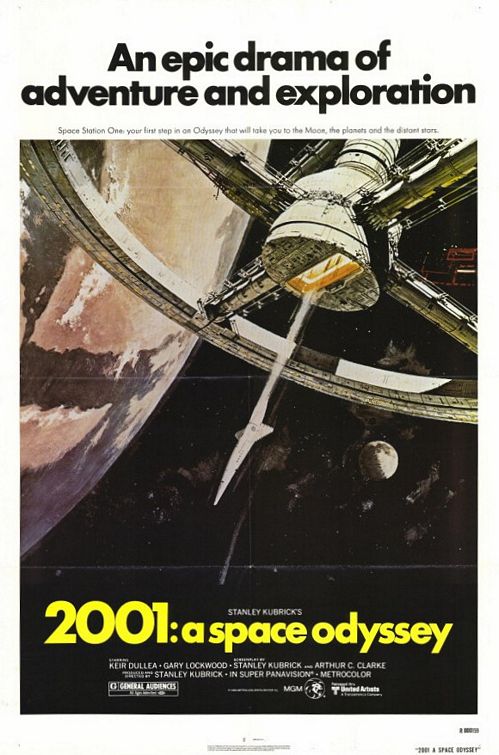
What I think of 2001: A Space Odyssey

This movie is not just good, its amazing. Besides providing us with good performances, original plot, fantastic special effects, thoughtful messages and a lot more, it was an, until then, completely unseen world to the public. This is the first sci-fi movie that takes us out into the unknown space of our galaxy with such splendid effects and mind bursting reality that the audience is left without words. I am only 17 years old, and therefore I was raised into a world of modern effects and 3D animations in the movies. But nonetheless I was really, and I mean completely, blown away by the quality of these effects, even after almost 40 years. The visual effects was just one of the merits of this movie, the camera was in true Kubrick style amazing and enchanting. It feels like you are consumed by the screen and sucked into this surreal world (especially in the round control room or whatever you call it). The effects, the camera and the sheer size of this movie caught me of my guards. The meaning of this movie can also be interpreted as you wish yourself, even though I think there are some clear points concerning humanity (also true Kubrick style). How humanity on top of its evolution is just maintenance on board, and therefore not needed by the computer, one of humanities tools. How we in space appear like babies, learning to walk once more, losing control of our tools in zero-gravity, breathing through equipment as fish out of water. On the peak of evolution, we set out into the never-ending adventure as simple primates. Many might think that the length and slow pace of this movie is, boring? ridicules? or just a waste of time. But before you can jump to those conclusions, think about why Kubrick spends time with calm music and a spaceship in the middle of space for several minutes. This is to illustrate the beauty of it. Beauty, beauty is in many cases not granted the rightful respect by viewers. Kubrick wants to show us beauty, and if we do not succumb to it and relax, we can not enjoy this film as it was intended. This is not an ordinary movie, we can not just sit and watch as we can with some other movies, this requires time, thoughts and above all commitment and feelings to watch. All of this together, makes this one of the greatest achievements in the world of moving pictures.
Thursday, October 9, 2008
What I think of HAL 9000

As the brain of the spaceship Discovery, HAL is a robot that uses the mechanical, sensing, and information systems under its control. HAL is an acronym standing for "Heuristically programmed Algorithmic computer." "Heuristic" and "Algorithmic" are two primary processes of intelligence.
HAL is capable of speech recognition, natural language understanding, lip reading, and thinking well enough to beat humans at chess. Along with all these capabilities comes the capacity for malevolence. HAL kills its astronaut crew. The audience is left wondering whether HAL is right, wrong, evil, or mad. An astronaut decides to shut down HAL 9000's higher cognitive functions, an experience equivalent to death for HAL. HAL's central core is depicted as a room full of brightly lit computer modules mounted in arrays from which they can be inserted or removed. As the astronaut removes the modules, HAL's intelligence degrades.
HAL has had a lasting effect not only on fiction, but also on the real world. It has inspired astronauts, scientists and philosophers. Scientists ask how its capabilities can be duplicated and philosophers have asked whether HAL was responsible for the murders of the astronauts. All of us ask whether we want to create intelligent machines that may someday endanger us.
I think that Hal was one of the most important characters in the movie 2001: A Space Odyssey because he shows us the next step in evolution. man is created , man makes tools , man makes weapons, man makes fire , man makes wheel, man goes to space, man makes new life. then the new life tries to kill man.
Subscribe to:
Posts (Atom)